
Constance Alabert
Chromatin Replication and Cell Identity
@cmalab.bsky.social
Current Research
Identifying replication coupled mechanisms ensuring the maintenance of cell identify in proliferating cells
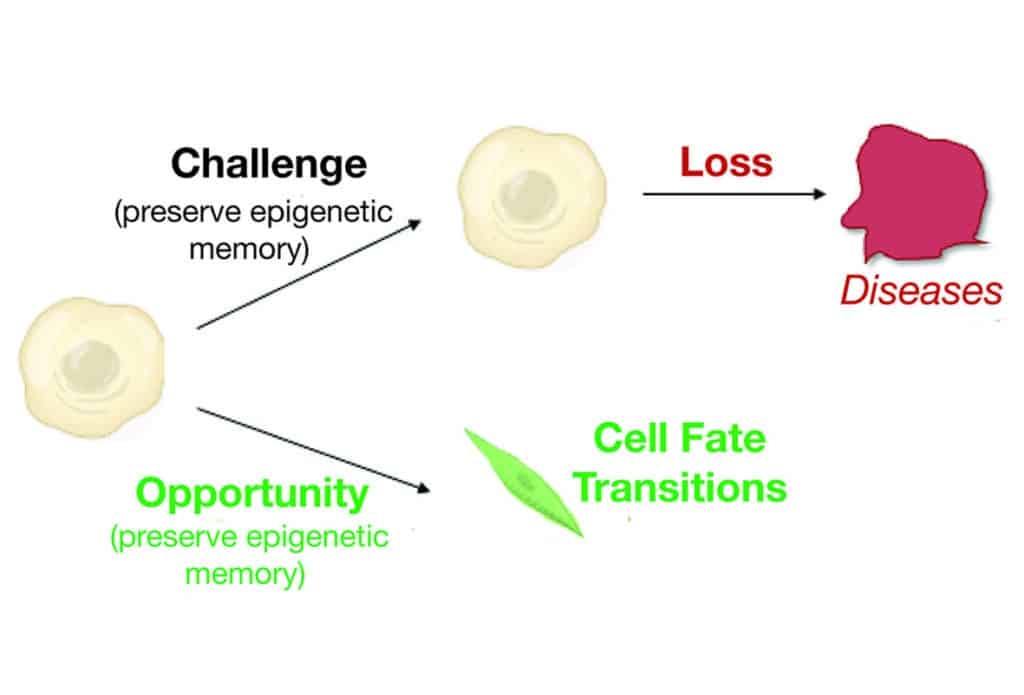
Identifying replication coupled mechanisms controlling cell fate transitions
Most of the proteins involved in the duplication of chromatin-based information are instrumental for normal development and are often found deregulated in human diseases such as cancer, premature aging, or intellectual disabilities. To understand epigenetic memory, we are using time resolved replication coupled mass spectrometry, from a couple of minutes after the passage of the fork to multiple subsequent cell cycles. This strategy enables us to uncover previously undetected interplay between chromatin-based pathways. This is a crucial step in advancing our understanding of the mechanisms behind the stability of epigenetic information under normal conditions and its disruption in disease contexts.
DNA replication is required for successful cell fate transitions across diverse physiological, experimental, and pathological contexts involving factors often deregulated in human cancer and intellectual disabilities. The underlying mechanisms are fundamental for our understanding of tissue specification and organ homeostasis but are poorly understood. We have discovered a profound and rapid rewiring of the proteins that are recruited around DNA replication forks, upon differentiation of human induced pluripotent stem cells (iPSCs) into mesoderm. We are exploring how DNA replication contributes to the mechanistic diversity of cell fate transitions.
Key Publications
View all Publications
RNA polymerase II promotes the organization of chromatin following DNA replication
Bandau, S., Alvarez, V., Jiang, H., Graff, S., Sundaramoorthy, R., Gierlinksi, M., Toma, M., Owen-Hughes, T., Simoli, S., Lamond, A., Alabert, C.
FAM111A regulates replication origin activation and cell fitness
Rios-Szwed, D.O., Alvarez, V., Sanchez-Pulido, L., Garcia-Wilson, E., Jiang, H., Bandau, S., Lamond, A., Alabert, C.
Life Sci. Alliance
(2023)
Group Leader
Constance Alabert
Constance was born in Montpellier in France and studied Natural Sciences at the University of Montpellier before joining the lab of Phillippe Pasero as a PhD student. Subsequently, Constance joined the lab of Anja Groth in Copenhagen as a postdoctoral fellow. In 2017, Constance started her group as a tenure track PI at what is now the Molecular Cell and Developmental Biology division in Dundee. In 2024, Constance joined DGI.
Constance’s group has made the following contributions to our understanding of chromatin replication and genome integrity:
- Revealed distinct phases in the restoration of euchromatin and heterochromatin after DNA replication, both in untransformed cells and in cancer cells.
- Uncover the essential role of transcription restart in the restoration of chromatin following DNA replication.
- Functional characterization of FAM111A, a protease involved in DNA replication initiation and associated with severe human developmental syndromes.
Group Members

Constance Alabert
Group Leader