

Agostina Bertolin
DNA-end Homeostasis in Health and Disease
bertolinlab.bsky.social
Current Research
DNA-end homeostasis in health and disease
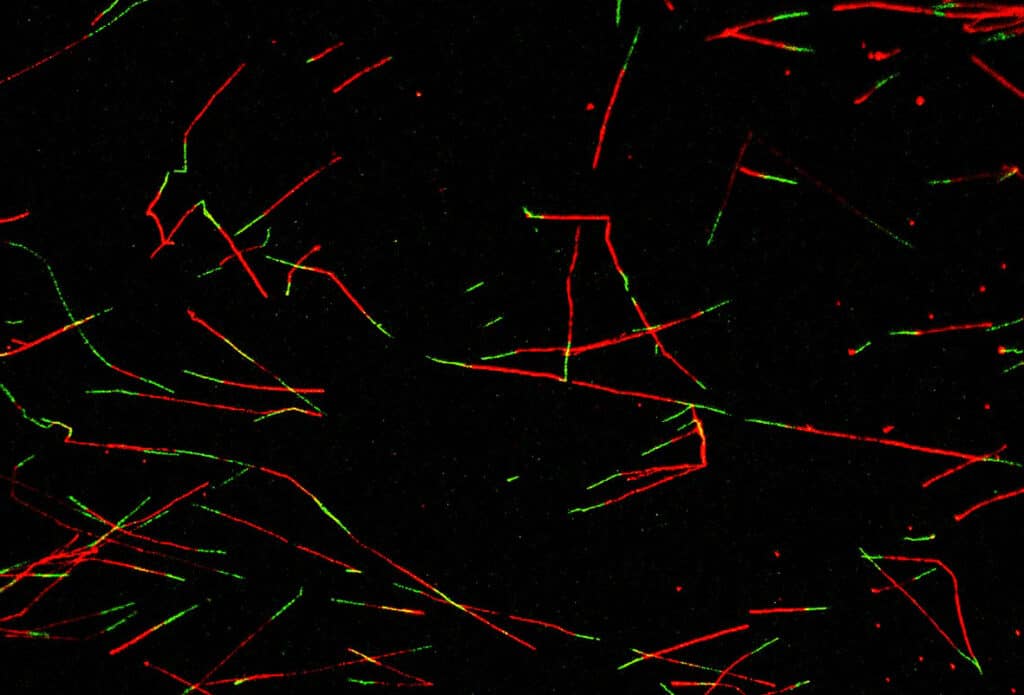
The lab studies how DNA-end homeostasis is maintained during replication of the human genome. This involves mechanisms that control the number, structure, and accessibility of DNA-ends at replication forks, with a particular focus on 3′ ends that are the starting point for processive DNA synthesis. We investigate how the regulation of DNA-end homeostasis promotes the stabilisation and progression of forks in healthy cells, whereas its deregulation drives fork collapse and genome instability in human cancer. The lab combines state-of-the-art molecular and cell biology in human cells with advanced biochemical reconstitution of DNA replication using purified human proteins. We also study the mechanistic link between DNA-end homeostasis and the remodelling of DNA replication forks that have stalled. Finally, we explore how excessive activation of replication origins in some types of human cancer can perturb DNA-end regulation and promote tumour cell death, genome instability, or resistance to anti-cancer therapies.
Key Publications
View all Publications
The DNA replication checkpoint prevents PCNA/RFC depletion to protect forks from HLTF-induced collapse in human cells.
Bertolin AP, Canal B, Yekezare M, Early A, Zeng J, Instrell R, Howell M, Diffley JFX.
The DNA replication checkpoint limits Okazaki fragment accumulation to protect and restart stalled forks.
Canal B, Bertolin AP, Lee GC, Drury LS, Minamino M, Diffley JFX.
Group Leader
Agostina Bertolin
Agostina Bertolin was born in Argentina, where she studied biology at the University of Buenos Aires (UBA), specialising in molecular and cell biology. Her PhD research at the Leloir Institute in Argentina explored how evolutionarily conserved responses to low oxygen intersect with ‘stemness programmes’ in Drosophila melanogaster. She then pursued her lifelong interest in DNA replication and genome stability as a postdoctoral researcher, initially with Vanesa Gottifredi at the Leloir Institue, where she studied DNA damage tolerance and translesion synthesis polymerases in human cells. In 2017, Agos joined the group of John Diffley at the Francis Crick Institute in London, where she subsequently received a Crick Award for Outstanding Contribution to World Class Science for her work improving scientific discourse.
In 2026, Agos was awarded a Wellcome Career Development Award to establish her independent group in the Division of Genome Integrity at the University of Dundee.
Agos has made important contributions to our understanding of how DNA replication shapes genome integrity:
- Showed how the DNA damage checkpoint pathway prevents the irreversible collapse of stalled DNA replication forks, via a combination of biochemical reconstitution of DNA replication with purified yeast proteins, and genetic screens in human cells.
- Showed that checkpoint control of origin firing and fork progression prevents the accumulation of Okazaki fragments, thereby limiting the generation of unprotected 3′-ends of DNA at stalled replication forks.
- Identified key enzymes such as HLTF that promote fork stabilisation in checkpoint-proficient cells but drive replication fork collapse when checkpoint signalling is compromised.
- Contributed to a multi-centre collaboration during the COVID-19 lockdowns to identify inhibitors of SARS-CoV-2 viral enzymes.
Group Members
